
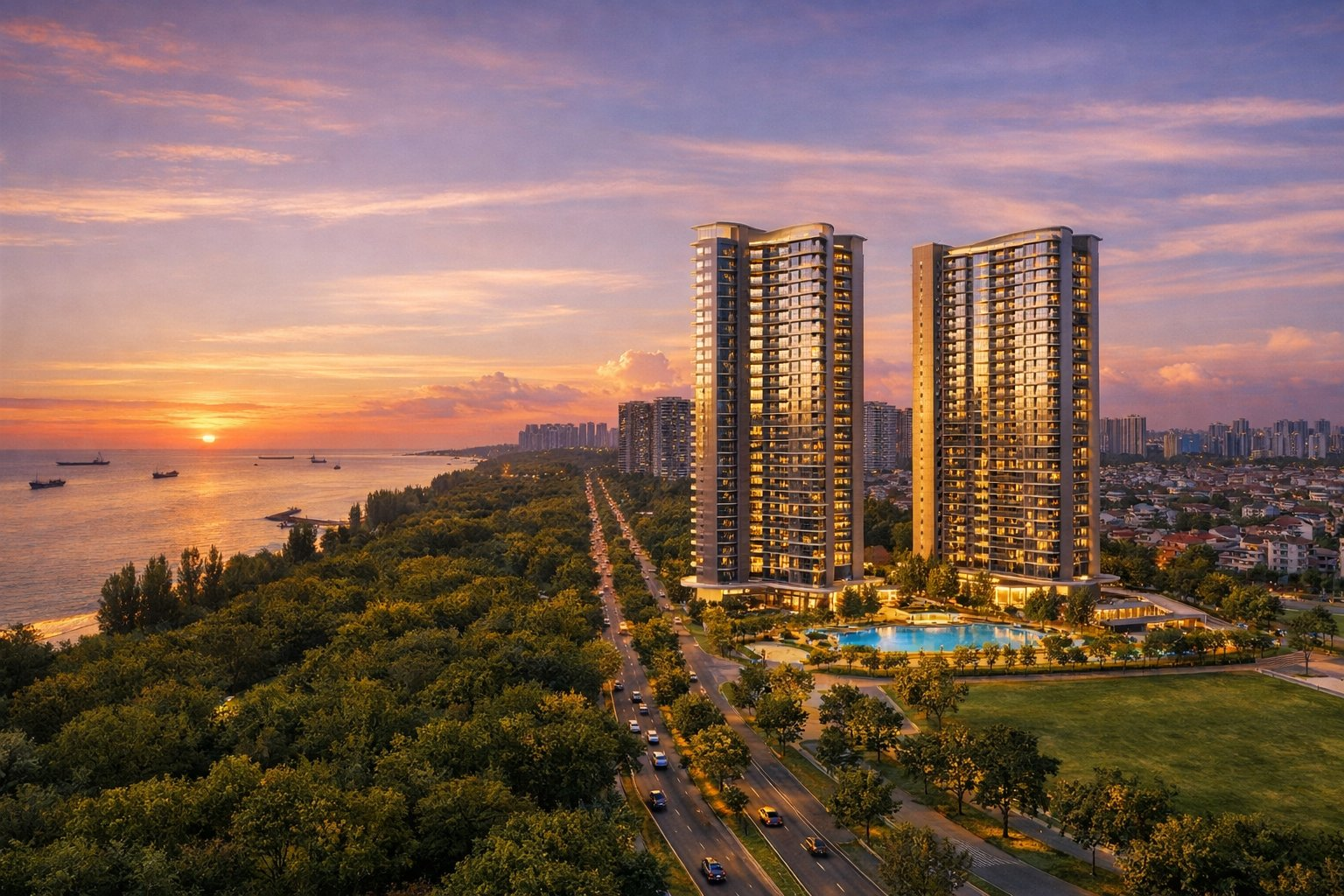
Vela Bay: Project Review for 2026 Buyers
Bayshore MRT Waterfront Living and First-Mover Positioning in District 16
View Vela Bay Project Page →Project Overview
Vela Bay is a 99-year leasehold private condominium located along Bayshore Road in District 16, developed by SingHaiyi Group under the Government Land Sales (GLS) programme. As the first private residential development in the new Bayshore precinct, it occupies a significant position within a master-planned, car-lite waterfront town that will eventually comprise approximately 10,000 homes.
The project sits directly beside Bayshore MRT (TE29) on the Thomson-East Coast Line, offering a rare combination of doorstep rail access, proximity to East Coast Park, and long-term alignment with the Bayshore and Long Island transformation plans. Its appeal is rooted in early entry into a precinct where subsequent land parcels are likely to be priced progressively higher as infrastructure, amenities, and residential density develop over time.
With 515 residential units and an estimated TOP of December 2030, Vela Bay is best understood as a premium, planning-led development for buyers who value first-mover positioning. It is likely to resonate most with East-side HDB upgraders, downsizers seeking MRT convenience and sea proximity, and longer-horizon investors focused on structural, planning-driven value.

Project Factsheet
Item | Details |
|---|---|
Project Name | Vela Bay |
Location | Bayshore Road, Singapore |
District / Region | District 16 / OCR / East Region (Bedok Planning Area) |
Tenure | 99-year leasehold |
Developer | SingHaiyi Group |
Site Type | GLS |
Development Type | Private Condominium |
Site Area | ~10,497.3 sqm |
Plot Ratio | 4.2 |
Total Units | 515 residential units |
Nearest MRT | Bayshore MRT (TE29), Thomson-East Coast Line |
Estimated TOP | December 2030 |
Location Context: Bayshore as a New Coastal Town
Vela Bay sits within the first phase of the Bayshore precinct, a new car-lite residential town planned between East Coast Parkway and Upper East Coast Road. Unlike older East Coast developments that grew incrementally over decades, Bayshore is being built with transport links, green corridors, and community infrastructure designed from the outset.
The most consequential locational advantage is direct access to Bayshore MRT (TE29), which delivers a one-seat rail connection to Marina Bay, Orchard, and Upper Thomson. This materially changes commuting dynamics for District 16 residents. Most older East Coast condominiums rely on feeder buses or private transport; Vela Bay does not.
The site also benefits from what can be described as a double-frontage position. The southern side faces East Coast Park and the future Long Island coastline, while the northern side connects into established Bedok and Siglap residential catchments, including reputable schools. This combination gives the project both lifestyle relevance and practical family appeal.
What Vela Bay Is and Is Not
Understanding this project requires being clear about what it offers and what it does not. This distinction matters. Vela Bay trades immediate retail convenience for planning clarity, exclusivity, and early positioning within a long-term transformation zone.
What it is: Vela Bay is a first-mover private development in a new master-planned coastal town. It offers doorstep MRT access aligned with car-lite, transit-first living. It is a pure residential development, not diluted by retail podiums or transport interchanges. Its value case is built on planning transformation and long-horizon appreciation rather than short-term excitement.
What it is not: An entry-level or affordability-led OCR launch, a short-term momentum play, a boutique low-density development, or a mixed-use mall-integrated site.
Unit Mix and Buyer Profile
Vela Bay's unit mix is more informative about buyer intent than any marketing positioning. The development is weighted towards mid-sized configurations, with 2 Bedroom Premium units forming the largest single segment. Three-bedroom and 3 Bedroom Premium units collectively anchor the family tier, while 4-bedroom and 5-bedroom units are comparatively limited in supply.
This is not a heavily investor-driven project. The mix signals a balanced own-stay development with a clear upgrader and family focus. Resale demand is likely to concentrate around 2 Bedroom Premium and 3-bedroom units, which have the broadest appeal. Larger units offer strong long-term own-stay value but with a narrower resale audience. The limited supply of 1-bedroom units also reduces rental-driven supply pressure over time, which supports more stable demand dynamics.
Amenities and Site Planning

Vela Bay's site plan follows a centralised facilities layout, where key communal areas are grouped within a main zone. This improves daily accessibility and makes shared spaces more practical for own-stay residents rather than dispersed across a large footprint.
Stack orientation introduces a clear trade-off that buyers should consider early. Inward-facing stacks are closer to facilities and communal zones, which suits families who prioritise daily convenience. Outward-facing stacks, particularly those oriented toward East Coast Park or more open surrounding plots, offer better privacy, airflow, and potentially stronger long-term resale appeal.
In a developing precinct where surrounding land parcels are still being released and built out, stack positioning today can influence both liveability and future resale dynamics. This makes it one of the more important decisions at the point of unit selection.
Buyer Suitability
East-side HDB upgraders are the core segment. These buyers are familiar with the East Coast lifestyle, value MRT proximity, and are looking to enter private housing within a familiar and improving area. They are comfortable with a developing precinct because they understand its long-term trajectory.
Downsizers and right-sizers from nearby landed enclaves represent another relevant group. They value the combination of sea views, security, lift access, and reduced maintenance that a private condominium provides, without the upkeep obligations of a landed home.
Long-horizon local investors focused on first-mover advantage within Bayshore make up the secondary segment. Their case rests on TEL connectivity, Changi-related employment demand, and coastal transformation over a holding period of eight to twelve years or more.
Buyers who are likely to be less satisfied include those seeking immediate retail convenience, low entry pricing, or short-term resale velocity. These buyers will find better alignment in more established parts of the East region.
Pricing Logic
Buyers of Vela Bay are effectively paying for three structural attributes rather than immediate lifestyle completeness.
The first is MRT-led accessibility as a long-term equaliser. Direct access to Bayshore MRT places the project in a different category from older East Coast condominiums. Over time, MRT proximity compresses lifestyle trade-offs for households that want East Coast living without car dependency. This supports both own-stay convenience and resale liquidity across market cycles. Crucially, MRT adjacency tends to matter more at exit than at entry, functioning as a value stabiliser rather than a launch-day pricing catalyst.
The second is future coastal transformation. The Long Island Project reframes East Coast living from a park-and-beach lifestyle into a multi-decade coastal resilience and land creation strategy. Buyers are paying for optionality — the right to be positioned early before outcomes are fully visible. The upside is gradual and structural, not immediate.
The third is controlled supply sequencing. Bayshore is being released in phases. Early projects like Vela Bay benefit from lower land cost bases compared to future GLS parcels, which are likely to be tendered at higher benchmarks once MRT operations and precinct momentum are more established. This sequencing supports pricing floors even when upside is measured.
URA Planning Context
URA's planning intent for Bayshore is evolutionary rather than explosive. The precinct is designed around transit-oriented residential growth anchored by the Thomson-East Coast Line, with a gradual introduction of amenities, community nodes, and green connectors. The Long Island Project will reshape the coastline over decades, adding land area and altering the coastal environment materially.
This supports long-term residential relevance, environmental resilience, and a steady uplift in perception over time. What it does not support is rapid price re-rating, short-term trading narratives, or lifestyle completeness in the early years. Vela Bay aligns with URA's long-cycle planning intent, and buyers should approach it with that same timeframe in mind.
Exit and Liquidity
In the short term, from launch through pre-TOP, liquidity exists but upside is limited. Sellers compete with developer inventory and future Bayshore supply. This phase is best suited to portfolio rebalancing rather than profit capture.
The strongest exit window is likely in the mid-term, from post-TOP through the early 2030s. By then, MRT usage will be embedded in daily commuting behaviour, nearby projects will have aged, and precinct amenities will be more tangible. Liquidity improves during this period, particularly for well-positioned stacks and practical unit sizes.
In the long term, beyond ten years, coastal transformation and land-use changes begin to have a more visible effect. Exit liquidity becomes selective but resilient, favouring buyers who entered at disciplined pricing with realistic holding expectations.
Risk Scenarios
Transformation lag is the most common risk. The Long Island and Bayshore upgrades are long-cycle by nature, and buyers expecting visible change within the first few years may feel misaligned.
Pricing sensitivity at launch is also relevant. If entry pricing overshoots the affordability thresholds of East-side upgraders, resale liquidity narrows and the buyer pool becomes more selective.
Future supply from Bayshore GLS releases creates a double-edged dynamic. New launches validate the precinct narrative but also introduce competition and pricing comparison pressure. Buyers should factor this in rather than treat it as a hidden risk.
Pros and Cons
Pros
Direct doorstep access to Bayshore MRT (TE29) on the Thomson-East Coast Line
Alignment with long-term coastal planning and the Long Island transformation
Lower land cost base as the first private launch in the precinct, relative to future sites
Strong own-stay relevance for East-side buyers and families
Cons
Limited immediate retail and lifestyle convenience in the surrounding area
Full precinct maturity will take a decade or more to materialise
Not suited for buyers with short holding horizons or those requiring immediate neighbourhood completeness
Takeaway
Vela Bay is a coherent choice for buyers who understand the value of entering a new coastal town early, particularly one anchored by MRT connectivity and long-term URA planning. Its relevance lies in being the first rather than the cheapest, planned rather than opportunistic, and connected rather than car-dependent. For buyers who are aligned with those priorities and comfortable with the holding horizon, the project's positioning holds up well. For those seeking immediate gratification or short-term upside, expectations need to be calibrated carefully.
Frequently Asked Questions
Is Vela Bay considered a waterfront project?
Vela Bay has genuine coastal adjacency through its proximity to East Coast Park and the future Long Island coastline. It is not a resort-style beachfront enclave, but the park connection and planned coastal transformation give it long-term waterfront relevance. Buyers should view this as lifestyle and planning upside rather than immediate premium monetisation.
How important is Bayshore MRT to this project's value?
It is a defining structural feature. True doorstep MRT access is rare in the East Coast area, and it materially reduces car dependency, improves daily convenience, and supports long-term resale liquidity. MRT proximity tends to become more important at exit than at entry, making it a durable advantage.
Is Vela Bay suitable for families?
It can suit families who prioritise MRT access, school proximity, and long-term planning potential over immediate retail convenience. The 3-bedroom and larger configurations support family living needs. However, the surrounding precinct is still developing, so buyers should approach it as a longer-term environment rather than an immediately complete estate.
Will future GLS sites in Bayshore compete with Vela Bay?
Future sites will introduce additional supply, but they are also likely to be launched at higher land costs as the precinct matures. This creates a structured supply progression rather than direct price competition. Early projects like Vela Bay may benefit from a relative pricing advantage compared to later launches.
Is the lack of immediate retail a concern?
In the near term, residents will rely on Bedok or Siglap for daily conveniences. This contributes to a quieter living environment but requires more travel for errands. Over time, planned amenities within the Bayshore precinct are expected to improve day-to-day convenience meaningfully.
What holding period makes sense for Vela Bay?
A holding period of eight to twelve years or longer is generally better aligned with the project's planning timeline. This allows MRT usage patterns to stabilise, the Bayshore precinct to mature, and the coastal transformation to become more visible. Buyers with shorter horizons should temper their expectations accordingly.
Who should reconsider Vela Bay?
Buyers who require immediate retail and lifestyle convenience, prefer the lowest entry pricing in the East region, or are focused on short-term resale will likely find better alignment elsewhere. Patience and a long-term perspective are prerequisites for this project.
Interested in Vela Bay?
Get the latest pricing and stack recommendations from a verified consultant — no obligation.