
The Sen: Floor Plans: Best Stacks, Layout Guide & What to Avoid
Unit Mix, Layout Breakdown and Stack Orientation Guide (District 21)
View The Sen Project Page →Overview
The Sen is structured around a practical, own-stay-focused layout strategy with its centre of gravity firmly in the 2-bedroom and 3-bedroom segments. The unit mix is designed for upgrader families and owner-occupiers rather than compact investor formats, and the range of study variants across key unit types reflects a deliberate attempt to serve households with evolving work-from-home and space flexibility needs.
With 225 units remaining across six configuration types, buyers still have genuine selection in most segments. The 1-bedroom is fully sold, and the standard 3-bedroom has seen the most proportional take-up relative to availability. The 3 Bedroom + Study and 4 Bedroom + Study configurations remain broadly available and are worth careful consideration by buyers who have adequate budget.
In a project where the surrounding environment is a primary lifestyle driver rather than MRT access or retail integration, stack orientation and facing carry particular weight. The most important layout decision at The Sen is often not which configuration to choose, but which stack within that configuration genuinely serves the household over a long holding period.
Key Floor Plan Facts
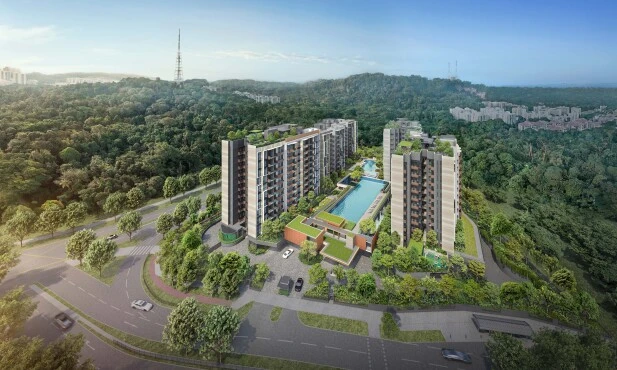
347 total residential units across 5 blocks of 10 storeys
Unit types range from 1 Bedroom to 4 Bedroom + Study
2-bedroom and 3-bedroom configurations together account for approximately 73% of total supply
1-bedroom supply was intentionally limited at just 10 units and is fully sold
Study variants are available across 2-bedroom, 3-bedroom, and 4-bedroom configurations
Units facing Old Jurong Road may offer views toward Bukit Batok Nature Park
Internal stacks face other blocks within the development, with privacy varying by floor level and block positioning
Plot ratio of 1.6 produces a lower-rise, relatively spacious site for the unit count
Full Unit Mix
Unit Type | Size Range (sqft) | No. of Units | % of Total | Positioning |
|---|---|---|---|---|
1 Bedroom | 452 | 10 | 2.9% | Entry (fully sold) |
2 Bedroom | 678 to 732 | 110 | 31.7% | Couples and first-time buyers |
2 Bedroom + Study | 764 to 775 | 57 | 16.4% | Flexible smaller households |
3 Bedroom | 872 to 1,109 | 90 | 25.9% | Core family segment |
3 Bedroom + Study | 1,259 | 40 | 11.5% | Larger family with study needs |
4 Bedroom + Study | 1,453 | 40 | 11.5% | Multi-generational households |
Total | 347 | 100% |
Current Remaining Availability
Unit Type | Size (sqft) | Remaining Units |
|---|---|---|
1 Bedroom | 452 | Fully Sold |
2 Bedroom | 678 to 732 | 61 |
2 Bedroom + Study | 764 to 775 | 49 |
3 Bedroom | 872 to 1,109 | 42 |
3 Bedroom + Study | 1,259 | 39 |
4 Bedroom + Study | 1,453 | 34 |
Total Remaining | 225 |
What the Unit Mix Reveals
The distribution confirms The Sen as an own-stay development rather than an investor-driven project. The deliberate scarcity of 1-bedroom supply (only 10 units originally) signals that the project was never designed around yield compression or short-term rental demand. The strong concentration in 2-bedroom and 3-bedroom formats serves the HDB upgrader and family buyer profile that drives genuine demand here.
The early sell-out of 1-bedroom units and the proportional absorption of standard 2-bedroom and 3-bedroom configurations reflect typical upgrader demand patterns — buyers entering at the most accessible quantum in their preferred bedroom count. The 3 Bedroom + Study and 4 Bedroom + Study configurations remain broadly available primarily because their higher quantum narrows the eligible buyer pool rather than because of any mismatch with buyer needs.
The study variants across multiple bedroom tiers are a deliberate design choice aligned with post-2020 household demands. For a project targeting families who plan long-term occupation, the ability to adapt a study room across different household stages — child's bedroom, work-from-home office, elderly parent's accommodation, guest room — adds meaningful long-term value that is difficult to quantify at purchase but becomes evident over years of living.
Layout Analysis by Unit Type
1 Bedroom (452 sqft) — Fully Sold These were the only true entry-level configurations and were absorbed early due to their sub-$1 million pricing. At 452 sqft they were functional for a single occupant or couple but offered limited flexibility for household growth or long-term adaptation. Their sell-out is consistent with investor and entry-buyer demand at the lowest available quantum. Buyers entering now must consider 2-bedroom configurations as their starting point.
2 Bedroom (678 to 732 sqft) Three sub-variants exist within this range, reflecting differences in size and likely stack orientation. At 678 to 732 sqft, these are practical layouts for couples and smaller households. The living and dining area is typically open-plan with the kitchen, and both bathrooms and bedroom sizes are functional rather than generous. Buyers considering this configuration should assess whether the size will remain comfortable across their full intended holding period, particularly if the household is likely to grow. With 61 units remaining, buyers have genuine stack and floor selection across this segment.
2 Bedroom + Study (764 to 775 sqft) This is the configuration that most frequently shifts buyers away from the standard 2-bedroom when they take time to compare properly. The study adds approximately 30 to 40 sqft of functional space that can serve meaningfully different purposes across the household's lifecycle. For a couple working from home, it functions as a dedicated workspace. For a household with a young child, it becomes a nursery or small bedroom. For a household later in the hold, it serves as guest accommodation or elderly parent space. With 49 units remaining, selection is still meaningful but will tighten as the 2-bedroom segment continues to absorb.
3 Bedroom (872 to 1,109 sqft) Six sub-variants span a substantial size range within the 3-bedroom category, from a more compact 872 sqft to a genuinely spacious 1,109 sqft. This range serves meaningfully different household profiles. The smaller 3-bedroom variants around 870 to 900 sqft suit younger families with one child who want the bedroom count at a manageable quantum. The larger variants approaching 1,000 sqft and above provide better bedroom separation, more generous living proportions, and a daily liveability improvement that is tangible over a long hold. Buyers should identify which sub-variant they are evaluating rather than treating the 3-bedroom category as uniform. With 42 units remaining, some sub-variants and stacks may be more constrained than others.
3 Bedroom + Study (1,259 sqft) With 39 of 40 units still available, this configuration has the most remaining selection in the project. At 1,259 sqft it is a well-proportioned family home that provides proper bedroom separation, a dedicated study or flexible room, and a living zone that can accommodate a family of four or five comfortably over a long hold. For buyers who can stretch to this quantum, the case for choosing the 3 Bedroom + Study over the standard 3-bedroom is strong. The additional space translates directly into better daily liveability and long-term household adaptability.
4 Bedroom + Study (1,453 sqft) This is the project's largest configuration and suits multi-generational households or families with multiple children requiring genuine room separation. At 1,453 sqft across four bedrooms plus study, the layout provides the most complete own-stay package in the development. With 34 units remaining, buyers have reasonable selection. However, the quantum at this configuration is the highest in the project, and buyers should assess both their long-term financial comfort and their realistic exit plan given the narrower resale audience for large-format units in a non-MRT-fronting leasehold development.
Stack Orientation and Facing
At The Sen, stack orientation is among the most consequential unit-level decisions. In a project where the environmental surroundings are a primary lifestyle attribute, the difference between a nature-facing and an internally-facing position is not simply a matter of preference — it affects daily liveability, natural ventilation, noise exposure, and long-term satisfaction in a development where the quiet green environment is part of what buyers are paying for.
Old Jurong Road facing stacks (toward Bukit Batok Nature Park) Stacks oriented toward Old Jurong Road have the potential for views toward Bukit Batok Nature Park and surrounding green areas, particularly from mid to upper floors. These positions offer a more open and pleasant daily outlook and benefit from the prevailing breezes coming off the greenery. They represent the strongest expression of the nature-adjacent lifestyle the project promotes and typically carry the higher end of the PSF range within each unit type. For buyers whose primary motivation for choosing The Sen is environmental quality, these stacks should be prioritised.
Internal stacks facing other blocks Stacks that face other towers within the development offer a more enclosed environment. Privacy varies significantly by floor level — lower floors with direct sightlines into adjacent blocks can feel constrained, while higher floors with adequate separation are more acceptable. Buyers considering internal-facing stacks should assess the specific inter-block distance and angle rather than making a blanket assessment. In some configurations, internal-facing stacks may still enjoy partial green outlooks depending on the geometry of the site layout.
Road and infrastructure-facing stacks Any stacks facing active roads or infrastructure should be evaluated for ambient noise, particularly at lower floors where road traffic is more audible. Given The Sen's positioning as a quieter residential enclave, road-facing positions at lower floors represent a meaningful liveability trade-off that is less consistent with the project's core appeal.
Practical Unit Selection Framework
Most buyers find it most useful to work through their decision in three stages before visiting the showflat.
Stage one — configuration. Identify the right bedroom count and whether a study variant is genuinely needed for the household's daily routines and anticipated lifestyle evolution over the holding period. For most families at The Sen, the answer sits between the 2 Bedroom + Study and the 3 Bedroom + Study, depending on budget.
Stage two — quantum comfort. Establish the total purchase price ceiling that is genuinely comfortable at current and moderately higher mortgage rates. Identify which specific sub-variants within the chosen configuration fall within that range.
Stage three — stack selection. Within the configurations and price range identified, assess which stacks offer acceptable facing, floor level, and privacy. Prioritise nature-facing stacks if the environmental quality of the project is a primary motivation. Be honest about whether an internally-facing position at a lower quantum is a genuine compromise or an unacceptable trade-off for the specific household.
Conclusion
The Sen is a layout-first, own-stay project where the 2 Bedroom + Study and 3 Bedroom configurations form the functional core and offer the strongest balance of usability and resale audience breadth. The 3 Bedroom + Study is underutilised relative to its remaining supply and represents a strong option for buyers with adequate budget. Stack orientation is an unusually important decision here given the project's nature-adjacent positioning — choosing the right facing is part of receiving the lifestyle the project promises.
With 225 units remaining, buyers have genuine choice. The most productive use of the evaluation process is to narrow to a specific configuration, quantum range, and orientation preference before the showflat visit rather than leaving all three open-ended for the sales floor to resolve.
Frequently Asked Questions
Which layout is best for a family at The Sen?
For most families, the 3 Bedroom or 3 Bedroom + Study offers the best balance of space, bedroom separation, and long-term usability. The 3 Bedroom + Study is generally the stronger choice for households planning a hold of seven years or more, given how significantly better the additional flexible room serves evolving household needs over time.
Is the 2 Bedroom + Study worth the premium over the standard 2-bedroom?
For buyers planning a genuine own-stay hold of five or more years, usually yes. The study adds functional flexibility that becomes more rather than less valuable as household circumstances evolve. The PSF premium for the Study variant is modest relative to the daily usability improvement.
How does block clustering affect privacy at The Sen?
Privacy at The Sen varies meaningfully by unit. Internal stacks on lower floors facing adjacent blocks at close proximity can feel quite enclosed, while higher floors and outward-facing positions offer considerably better openness. Buyers should specifically ask about inter-block distances and angles for the stacks they are considering rather than relying on site plan impressions alone.
Should buyers prioritise nature-facing stacks even at a higher PSF?
For buyers whose primary motivation in choosing The Sen over a more centrally located alternative is the environmental surroundings and quieter lifestyle, nature-facing stacks are a central part of what they are paying for. Accepting an internal stack at a lower PSF may save quantum but undermines the core reason for choosing the project. Buyers should be honest with themselves about which trade-off is more acceptable.
Is the 4 Bedroom + Study good value at The Sen?
It is for households with a genuine need for the space. The configuration provides the best daily liveability of any unit type at The Sen, but the resale audience for a 1,453 sqft unit in a 99-year leasehold non-MRT-fronting project is narrow. Buyers should enter this configuration with a clear long-term own-stay plan rather than expecting a straightforward exit within a short holding period.
Are the layouts post-harmonisation efficient?
Yes. The layouts at The Sen benefit from post-harmonisation floor area calculations, meaning included areas such as balconies and AC ledges are more transparent. The internal liveable proportions are generally practical for the unit sizes quoted, though buyers should always verify bedroom dimensions against their actual furniture before committing.
Interested in The Sen?
Get the latest pricing and stack recommendations from a verified consultant — no obligation.