
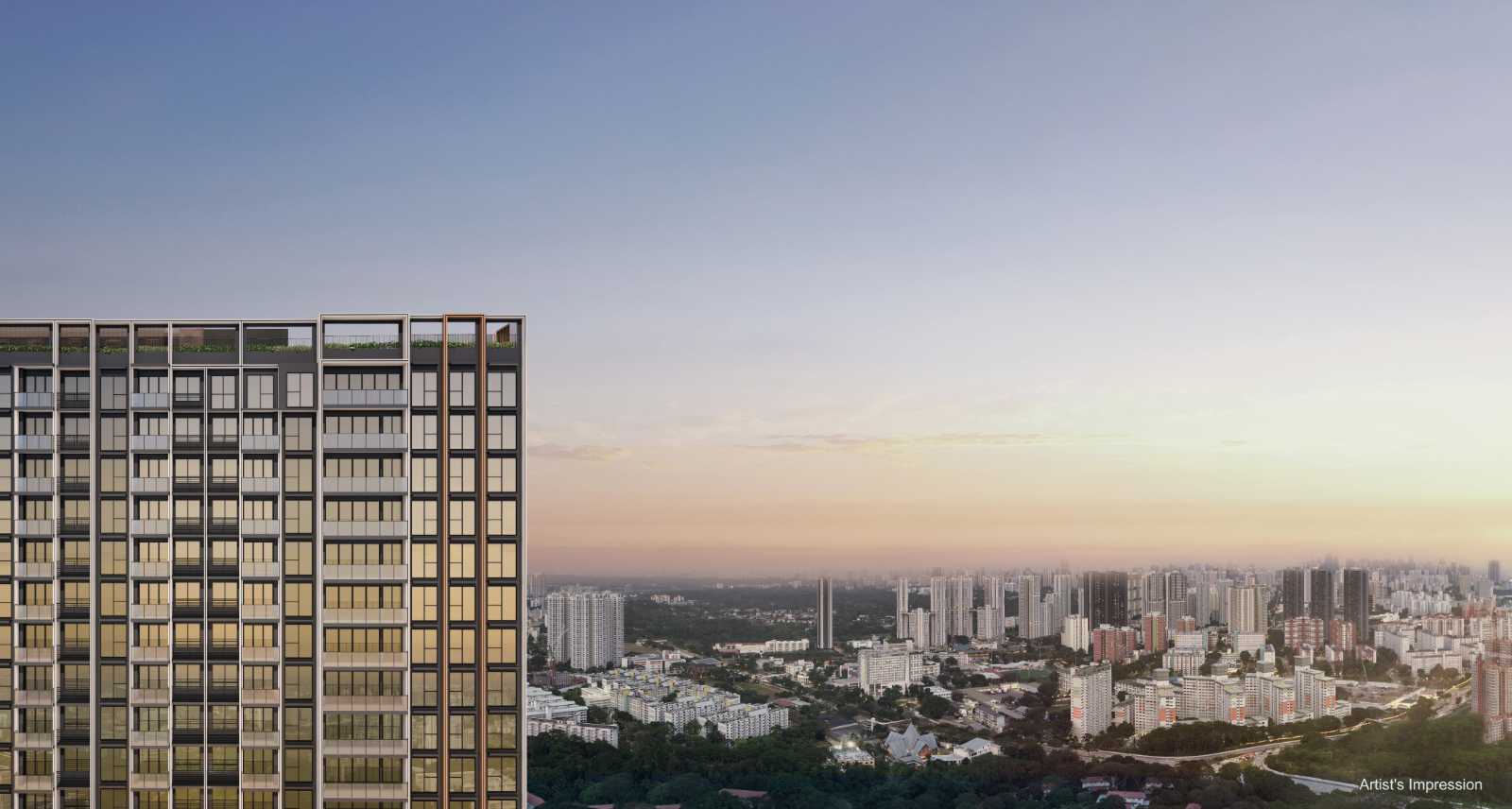
Hudson Place Residences: Project Review for 2026 Buyers
Work-Adjacent Living in Media Circle for One-North Professionals (District 5)
View Hudson Place Residences Project Page →Summary
Hudson Place Residences is a 99-year leasehold private residential development located at 18 and 20 Media Circle in District 5, developed by Qingjian Realty, Forsea Holdings, and Hoovasun Holding under the Government Land Sales (GLS) programme. The project comprises 327 residential units with a small first-storey commercial component, and forms part of Media Circle's planned transition from a media-industrial zone into a high-density residential enclave serving the one-north employment ecosystem.
Unlike MRT-fronting projects in Buona Vista or Clementi, Hudson Place Residences is positioned as a work-adjacent, rental-oriented development rather than a transport-led lifestyle project. Its value proposition rests on proximity to Mediapolis, Biopolis, Fusionopolis, and the National University Hospital, targeting tenants and buyers who prioritise walking or short commutes to work over doorstep MRT access.
This review assesses Hudson Place Residences from a decision-stage perspective, focusing on who the project realistically works for, what buyers and investors are paying for, and the structural trade-offs involved in choosing a Media Circle address over MRT-centric one-north alternatives.
Project Factsheet
Item | Details |
|---|---|
Project Name | Hudson Place Residences |
Location | 18 and 20 Media Circle, Singapore |
District / Region | District 5 / RCR (Queenstown Planning Area) |
Tenure | 99-year leasehold |
Developer | Qingjian Realty, Forsea Holdings and Hoovasun Holding |
Site Type | GLS (Media Circle, Parcel A) |
Development Type | Private Residential with first-storey commercial |
Site Area | 7,629.7 sqm |
Plot Ratio | 3.7 |
Total Units | 327 |
Nearest MRT | One-north MRT (CC23), approximately 1.0 to 1.1 km |
Launch Date | 1 May 2026 |
Estimated TOP | 29 September 2029 |
Location Context: The Media Circle Pivot
Hudson Place Residences sits within Media Circle, an area undergoing a deliberate shift from a media-industrial zone into a residential support cluster for the one-north precinct. This is not organic neighbourhood change. It is a planned, supply-driven transformation, with multiple GLS plots intended to inject over 1,500 new homes into this micro-district over time.
The most important distinction buyers must understand is that Media Circle is employment-first, not transport-first. The project sits approximately 1.0 to 1.1 km from one-north MRT, which places it outside convenient doorstep-MRT positioning for most residents. Practically speaking, Hudson Place functions as a bus-reliant or walk-to-work address, depending on where occupants work within the Mediapolis and Biopolis clusters. This positioning immediately narrows and clarifies the buyer and tenant profile.
Work-Adjacency Over MRT Adjacency
For projects in and around one-north, proximity to employment nodes often carries more weight than proximity to MRT stations. Hudson Place Residences leans fully into this logic.
Its immediate adjacency to Mediapolis, and short travel times to Biopolis, Fusionopolis, and NUH, make it an effective on-campus housing solution for professionals in media, technology, research, and healthcare. For these occupants, eliminating a daily commute can outweigh the inconvenience of not being beside an MRT station. This is a functional advantage, not an aspirational one, and it shapes both rental demand patterns and buyer satisfaction over time.
Facilities and Site Planning
Hudson Place Residences is designed as a compact, efficiency-led development. Facilities prioritise daily usability and tenant appeal rather than resort-style scale or lifestyle branding.
The site plan is anchored by a 50-metre main pool, which forms the primary communal space. This is supported by indoor and semi-outdoor social lounges, function rooms, gym and fitness facilities, a tennis court, and landscaped green areas integrated throughout the development. The overall facilities mix is calibrated for high usage by working professionals rather than for visual grandeur.
The facilities strategy reinforces the project's core positioning. This is not a resort-style family development. It is a functional, compact development designed to support rental demand, tenant convenience, and daily operational efficiency for professionals working within one-north.
The Commercial Component
The first-storey commercial space at Hudson Place Residences is modest in scale but plays a meaningful supporting role. Media Circle currently lacks everyday F&B and convenience retail, and Hudson Place is positioned to become a small neighbourhood node for cafes or essential services within the immediate area.
This is unlikely to drive material resale price uplift on its own, but it improves tenant stickiness and day-to-day liveability, particularly for professionals working long hours within the one-north cluster.
Buyer Suitability
Investors targeting one-north rental demand represent the primary buyer group. The tenant pool is anchored by media and technology professionals in Mediapolis and nearby campuses, researchers, post-graduate staff, and visiting faculty from Biopolis, INSEAD, ESSEC, and NUS, and healthcare professionals from NUH seeking quieter, work-adjacent housing. These tenants tend to prioritise proximity to work and unit modernity over MRT adjacency, particularly when a meaningful pricing gap exists relative to MRT-fronting projects.
Young professionals and dual-income couples working in one-north represent a second relevant segment. For them, Hudson Place functions as a low-maintenance live-work arrangement. The appeal lies in reclaimed daily time rather than lifestyle prestige. This buyer profile is less sensitive to family-centric amenities and more focused on efficient layouts, smart-home features, and work proximity.
Academic and medical own-stay buyers form a smaller but credible third segment, including academics, researchers, and medical professionals who value quieter surroundings compared to the busier Buona Vista MRT interchange. For them, Hudson Place is a functional own-stay choice tied to work location rather than a lifestyle-driven purchase.
Buyers who should eliminate this project early include those requiring doorstep MRT access for daily commuting, those purchasing for family-centric living or primary school planning, those expecting broad mass-market resale demand similar to MRT-fronting projects, and buyers who are uncomfortable with rental-led valuation logic. These are structural characteristics of the project, not shortcomings.
Pricing Logic
Hudson Place Residences should not be evaluated using conventional RCR or OCR pricing frameworks. Its pricing is shaped primarily by rental economics, employment adjacency, and relative entry positioning within the one-north ecosystem, rather than by MRT proximity or family-led own-stay demand.
The project entered the land market at a GLS cost of approximately $1,037 per square foot per plot ratio (psf ppr), which is meaningfully lower than nearby Media Circle plots awarded earlier, including Bloomsbury Residences. This creates room for a relative entry discount compared to adjacent developments rather than a headline premium.
Buyers at Hudson Place are paying for access to one-north's employment ecosystem, new-build quality in a supply-constrained work cluster, and a lower entry point relative to MRT-fronting peers. Pricing is expected to track rental demand rather than market sentiment, which makes it steadier in nature rather than subject to sharp appreciation.
Absolute quantum matters more than PSF in this project. Core buyers are investors and young professionals. Smaller unit formats favour affordability. Rental viability depends on achievable monthly rents rather than PSF comparisons. If entry pricing rises too close to MRT-fronting alternatives, Hudson's rental logic weakens quickly, so pricing discipline at entry is particularly important here.
URA Planning Context
URA's planning direction for Queenstown and one-north is intensification rather than suburbanisation. The continued densification of one-north as a global innovation hub, the expansion of residential supply around employment clusters, the Health District at Queenstown initiative, and improved park connectors and car-lite mobility all reinforce the area's long-term relevance as a working and living precinct.
For Hudson Place Residences, this means demand is anchored to employment rather than schools, rental demand is reinforced by policy-backed job growth in the area, and residential supply increases will continue to be concentrated within similar micro-clusters. This supports the rental thesis but also means future Media Circle GLS releases will create ongoing competition.
Exit and Liquidity
For work-adjacent, rental-led projects like this one, resale demand is narrower but repeatable. Liquidity is strongest when rental yields remain attractive relative to entry pricing, and the buyer pool contracts quickly if prices rise too far above MRT-fronting alternatives.
The most sensitive exit variables are the health of one-north employment, the interest rate environment, and relative pricing versus MRT-fronting competitors. The project is less sensitive to lifestyle branding or family-cycle demand patterns. Buyers should plan for a medium to long-term holding period, during which rental income forms the primary return and resale liquidity remains selective.
Risk Scenarios
Soft rental market: Reduced rental demand places pressure on yields. Entry price discipline becomes critical in this environment, as resale buyers will also have reduced appetite.
Rising interest rates: Yield compression makes the investment case less compelling for leveraged buyers, which can slow resale absorption.
Continued one-north expansion: Deeper tenant demand from sustained employment growth in the precinct supports both rents and exit viability over the medium term.
New Media Circle supply: Additional GLS releases in the cluster increase competition and place ongoing pressure on pricing differentiation. Hudson Place must remain competitively priced relative to newer entrants.
Pros and Cons
Pros
Strong employment adjacency to Mediapolis, Biopolis, Fusionopolis, and NUH
Lower land cost base than several nearby Media Circle peers
Clear and deep professional rental demand pool
Manageable project scale of 327 units
Cons
Approximately 1.0 to 1.1 km from one-north MRT, with no doorstep rail access
Narrow resale buyer pool concentrated among work-adjacent and investment buyers
Valuation is yield-dependent rather than broad lifestyle-driven
Limited family-centric appeal
Takeaway
Hudson Place Residences works best as a yield-first, work-adjacent asset for buyers and investors who genuinely understand one-north's employment-driven housing dynamics. It works poorly for buyers seeking MRT-centric convenience, broad family appeal, or lifestyle-led prestige. Its success depends less on mass-market desirability and more on sustained demand from a specialised professional tenant base whose work location happens to sit minutes away from the front door.
Frequently Asked Questions
Is Hudson Place Residences primarily an investment or own-stay project?
It is primarily structured for investors. The one-north employment ecosystem creates a tenant-driven demand base that supports rental logic more than family-centric living. Own-stay demand exists but is niche and tied to work proximity rather than lifestyle preference.
How significant is the distance to one-north MRT?
It is a real consideration and should not be minimised. For occupants who commute by train, the 1.0 to 1.1 km walk is a daily friction point. For tenants working within Mediapolis or nearby campuses, however, walk-to-work convenience often outweighs the lack of MRT frontage.
Who are the most likely tenants at Hudson Place Residences?
The core tenant pool consists of media, technology, research, and healthcare professionals within the one-north cluster. These tenants typically prioritise work proximity, modern interiors, and unit quality over MRT access. This creates a specialised but consistently replenished rental demand base.
Is this comparable to MRT-fronting projects like Blossoms by the Park?
Not directly. MRT-fronting projects appeal to a broader mass-market buyer pool and tend to command stronger resale optics. Hudson Place trades MRT access for lower entry pricing and work adjacency, which produces different buyer behaviour and exit dynamics.
Does the commercial space materially improve value?
It improves daily convenience and tenant stickiness in an area currently lacking F&B options. It should be viewed as a supportive feature rather than a primary price driver. Its impact is functional rather than speculative.
What holding period makes sense for this project?
A medium to long-term holding period is more appropriate. Returns are more likely to accrue through steady rental income than through short-term price appreciation. Buyers should align expectations with rental economics rather than quick-cycle resale gains.
What is the biggest risk buyers should watch?
Overpaying relative to MRT-fronting alternatives is the most consequential risk. If entry pricing is not meaningfully below MRT-fronting projects, both the rental yield advantage and the resale exit logic are undermined.
How does Hudson Place compare to Bloomsbury Residences?
Both are Media Circle projects targeting similar tenant pools. The key comparison points are land cost, unit mix, pricing, and layout quality. Hudson entered at a lower land cost than Bloomsbury, which gives it more room to price competitively, but buyers should evaluate both in the context of remaining availability and current pricing.
Interested in Hudson Place Residences?
Get the latest pricing and stack recommendations from a verified consultant — no obligation.